Ingredients
Equipment
Method
Before mixing the dough, place your butter in the freezer so it's frozen by the time you grate it into the dough.
Mix Dough
- In a bowl, mix the water and active sourdough starter until slightly "frothy".350 grams water, 100 grams active sourdough starter

- Add the bread flour and salt to the frothy mixture, and mix until no dry flour remains.500 grams bread flour, 10 grams salt

- Cover the dough and let it rest on the counter for 30 minutes.

If the dough feels uneven or dry, finish mixing by hand to fully combine it.
Stretch-and-folds
- After 30 minutes, perform your first round of stretch-and-folds.

- Cover the dough and let it rest for another 30 minutes.
- While your dough is resting, grate the frozen butter into a separate bowl.

- Return the grated butter to the freezer until the 2nd round of stretch-and-folds.113 grams salted butter
- After another 30 minutes, remove the grated butter from the freezer. Perform your second round of stretch-and-folds, adding about ¼ of the butter at a time as you fold the dough. Continue folding gently until all the butter has been added.
- Cover the dough and let it rest for 30 minutes.
- After 30 minutes, perform the last round of stretch-and-folds. When completed, cover the dough and set it on the counter for bulk fermentation.

Stretch one side of the dough upward and fold it over onto itself. Rotate the bowl and repeat 4 to 5 times.
Bulk Fermentation
- Bulk fermentation can take between 4 and 12 hours, depending on room temperature and dough temperature.
Adding the frozen butter will slow down bulk fermentation for a period. Also, don't attempt to speed up bulk fermentation by "warming" the dough unnaturally, or else the butter will begin to melt. Room-temperature fermentation works best for this dough; keep a close eye on it.
Bulk fermentation is done when the dough is jiggly like Jell-O, with bubbles on top and almost doubled in size. Watch your dough, not the clock!
Shaping and Cold Proofing
- Once your dough has completed bulk fermentation, it's time to shape it, place it in a banneton or bowl, and refrigerate it for 6 to 12 hours.
- Remove the dough from the refrigerator and, on a clean surface, turn the dough out.
- Using gentle push-and-pull motions, shape the dough into a smooth ball.
- Dust your banneton or bowl with flour (or rice flour) to help prevent sticking.
- Carefully, turn your dough upside down into the banneton. Cover tightly and place the dough in the refrigerator for 6 to 12 hours.

You should not need flour to shape your dough. If it's sticky, sprinkle some water on the surface before turning your dough out.
Pull the dough slightly toward you, then gently push it away while rotating it to build tension on the surface. Think of it like gently tucking the dough underneath itself to make the top smooth and tight.
Score and Bake
- Place your Dutch oven or heavy-bottom pot inside a cold oven, lid on, and preheat it to 400℉.
- Remove the dough from the refrigerator and transfer it to a piece of parchment paper or a dough sling, if using one.

- Using a bread lame or a serrated knife, score the dough ¼ - ½ inch deep at an angle from front to back to help the loaf expand in the oven.

- Lightly spray the loaf with water or add a few ice cubes to the pot for extra steam.
- Carefully place your loaf into the Dutch oven or heavy-bottom pot, then place the lid on and bake for 30 minutes.
- After 30 minutes in the oven, remove the lid and let it bake for another 5 to 10 minutes to let it brown. The loaf is fully baked when the internal temperature reaches 208℉ to 210℉.
- Once your loaf is fully baked, remove it from the oven and let it rest in the pot for 10-15 minutes before transferring it to a cooling rack.

Allow your Dutch oven or heavy-bottom pot to heat up for 20 to 30 minutes after the oven says it's preheated. You want both the oven and the Dutch oven fully heated before baking.
Don't be scared of scoring; the more you practice, the easier it gets. As long as your loaf has a confident angled score, it'll bake up beautifully.
You may see a little butter at the bottom of your pot; that's normal.
Cool and Slice
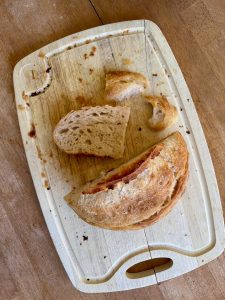
- Allow your loaf to cool for 2 hours before slicing.
- Once completely cooled, slice and enjoy!

It's important that you allow the loaf to cool before slicing. I promise, it's worth it!
Notes